How I Got 2 A*s and an A in A Levels CAIE
Before Bilal Soomro became an A-Level teacher at Tutify, he had to figure out what actually worked as a student. His biggest lesson: more hours did not necessarily mean better marks.
Before I started A Levels, my seniors had already done a good job of frightening me. I heard constantly about how difficult the next two years would be, how enormous the jump from O Levels/IGCSE was, and how much harder I would have to work. So, during my first week of classes, I made a promise to myself: whatever I learned in class, I would revise again that same day.
For a while, I thought I was doing everything right. My notes were up to date. I was studying regularly. I was putting in the hours. But my grades were not improving in the way I expected.
That was probably the first important thing A Levels taught me: effort and marks do not always move together in a straight line.
I had assumed that if I studied twice as much, I would naturally become twice as good. A Levels quickly showed me otherwise. You can spend hours reviewing a chapter and still struggle when the same concept appears in an unfamiliar past-paper question. You can understand everything a teacher says in class and still lose marks because you have not learned how the examiner expects you to apply it.
Eventually, I stopped asking myself how many hours I had studied and started asking a different question: What, exactly, did I accomplish today?
I stopped measuring my study in hours.
I made a planner for every subject and wrote down every topic I needed to complete. From there, I created monthly targets and then weekly ones. Instead of deciding that I needed to study Physics for four hours, I might decide that I needed to understand a particular concept, complete its topical questions and review the mistakes I made.
That change sounds small, but it completely changed how I thought about studying.
My first few months were not extraordinary. I was still adjusting to AS Level. In Physics, I was working through Physical Quantities. In Mathematics, I was studying topics such as Binomials and Series. In Chemistry, I was covering Atomic Structure and Chemical Bonding while gradually beginning topical past-paper practice.
The important part was not how quickly I moved. It was that every topic became something I could deliberately finish rather than something I had merely “spent time on.”
Over time, my study routine settled into a pattern that I continued using throughout A Levels: I would attend the lesson, reconstruct what I had learned in my own notes, make sure I understood the underlying concepts and terminology, and then test that understanding through past-paper questions.
The order mattered.
During a lesson, I tried to listen properly rather than spending the entire class copying every sentence my tutor wrote. Afterwards, I would make my own notes and include the details I had found difficult, the questions I had asked and the connections between ideas that I wanted to remember.
Then came the part that, in my experience, makes the biggest difference at A Level: past papers.
Knowing the content and knowing how to answer an A-Level question are related, but they are not exactly the same skill. Past papers expose the gap between the two.
The questions I got wrong became the most useful ones
When I got a question wrong, I tried not to treat checking the mark scheme as the end of the exercise. I wanted to know why I had got it wrong.
Was there a gap in my understanding? Had I misunderstood the wording? Did I know the concept but fail to recognise where it applied? Had I fallen for a distractor in an MCQ?
For difficult chapters, I would return to my notes and then repeat the topical questions. Sometimes I repeated the same material several times. I went through Kinematics MCQs around three or four times because I was not satisfied with simply knowing which answer was correct. I wanted to understand the reasoning well enough that a differently worded version of the same concept would not catch me again.
That process could be frustrating because improvement was not immediate.
For roughly the first few months of A-Level Physics, MCQs were particularly difficult. I would practise and expect my score to jump, only to find that the next paper still contained questions that seemed impossible. There were moments when the amount of work I was doing did not appear to match the result I was getting.
I kept practising anyway.
There was no single lecture, book or trick that suddenly changed everything. The improvement was gradual enough that I almost did not notice it happening. But after months of solving questions, reviewing mistakes and revisiting weak topics, unfamiliar questions began to feel less unfamiliar.
I started recognising what the question was actually testing. I became better at identifying which information mattered and which did not. Distractors became easier to spot. Concepts that previously required a lot of effort began to feel more natural.
For me, the difference became particularly noticeable later in the academic year. The work I had been doing for months had finally started to show in my scores.
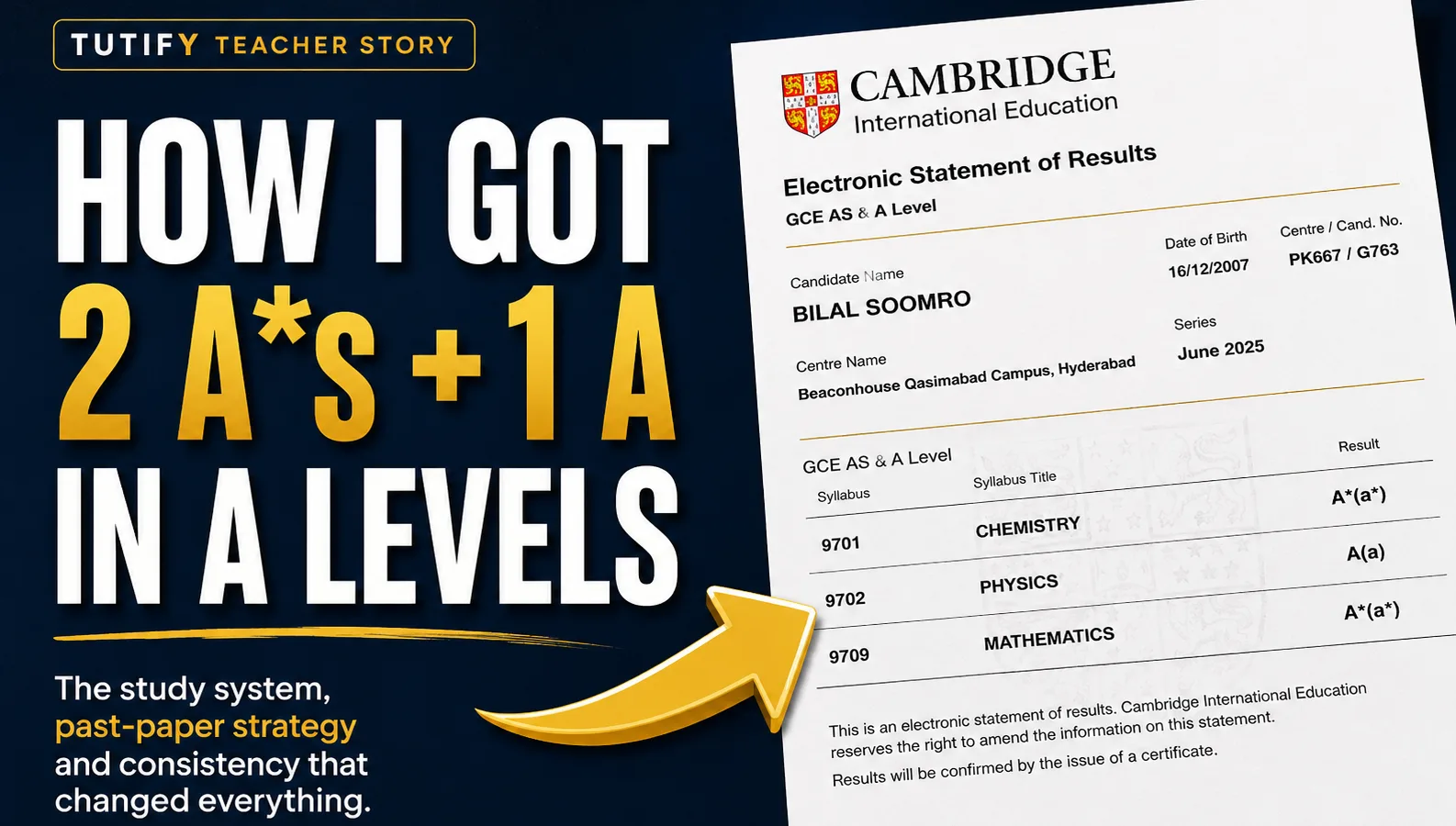
I eventually completed my Cambridge A Levels with A in Chemistry, A in Physics and A in Mathematics.**
Those grades are what appear on the result sheet. But looking back now, the more useful part of the experience was understanding what produced them.
Consistency mattered more than intensity
A Levels taught me that there is a big difference between studying intensely and studying consistently.
A student who works for 10 or 12 hours a day for a short period can feel incredibly productive. But A Levels are too large to depend on occasional bursts of motivation. The student who keeps learning, practising, correcting and returning to weak areas week after week has an enormous advantage.
That does not mean every student needs exactly the same routine I used. Some students make detailed notes; others work better from concise summaries. Some need more topical practice, while others need to spend longer rebuilding the underlying concept. What matters is having a system that reveals your weaknesses instead of allowing you to repeatedly study what already feels comfortable.
Today, this experience affects the way I think about teaching.
When a student tells me that they have been studying hard but their marks are not improving, I understand the frustration because I remember experiencing it myself. My first instinct is not simply to tell them to “work harder.” I want to know where the marks are being lost, whether the problem is conceptual understanding, application, exam technique or the way they are practising.
A student does not always need more work. Sometimes they need better-directed work.
There are plenty of things I remember fondly about A Levels beyond the grades — conversations with tutors, lessons that had nothing to do with the syllabus and the friends who made two demanding years much more enjoyable. But if I had to reduce the academic side of the experience to one lesson, it would be this:
A Levels are a marathon. Consistency gives good work enough time to compound.
I did not see the result of every study session immediately. Often I saw it months later.
And, in the end, that made all the difference.
Tutify editorial note
Bilal Soomro now teaches IGCSE/A-Level students at Tutify. His approach in the classroom reflects many of the lessons he learned as a student himself: build the concept first, use past papers deliberately, understand mistakes rather than merely correcting them, and measure progress by mastery rather than hours spent at a desk.
Share