Your Child Got a 6 in IGCSE—Is That Good Enough for A Levels in Dubai?
Confused by IGCSE grades 9 to 1? This simple guide explains what each grade means, whether a 4, 5, 6 or 7 is good, and what UAE parents should do next.
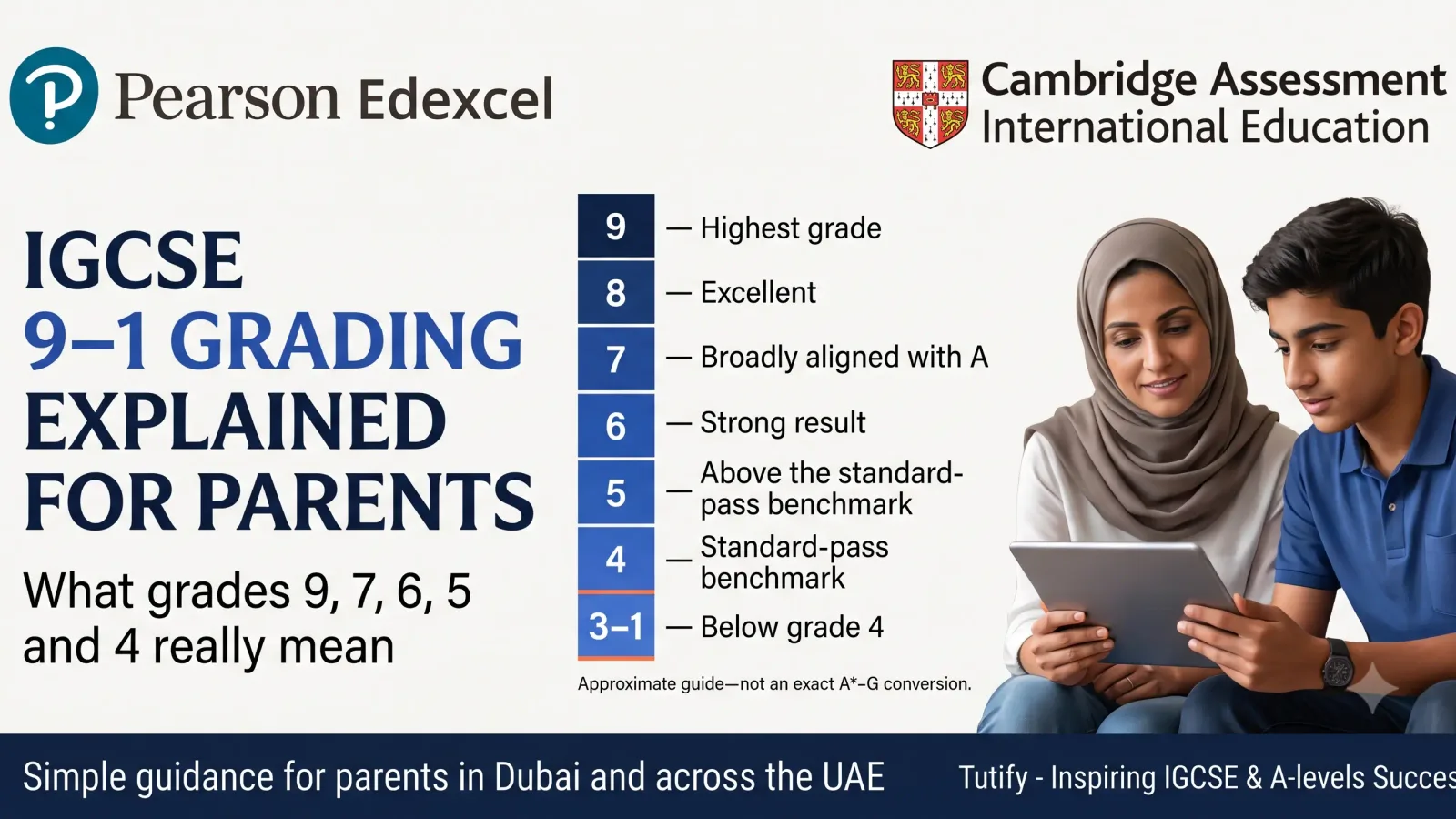
Your Child Got a 6 in IGCSE—Is That Good Enough for A Levels in Dubai?
Your child's IGCSE result shows a 6. It looks respectable—but what does it actually mean? Is it equal to an A, B or C? Is it enough to continue the subject at A-Level? Should you celebrate, or should your child strengthen certain areas before the next stage begins?
These are common questions for parents across the UAE, especially when one school uses numerical grades and another still follows the A*–G system.
The short version: grade 9 is the highest, grade 1 is the lowest awarded grade, and U means ungraded. But the 9–1 scale is not a clean swap where each number matches one old letter. Use conversions as a guide, not a precise translation.
More importantly, a grade tells you the result. It does not tell you why your child got it, which topics cost the marks, whether exam technique was the real problem, or whether the foundations are strong enough for A Level. That's the part worth investigating.
IGCSE grades 9 to 1, explained simply
Grade | What it means | Approximate old grade |
|---|---|---|
9 | Exceptional | Above the old A* |
8 | Excellent | Around A* |
7 | Very strong | Broadly A |
6 | Strong | Around B |
5 | Good | Between B and C |
4 | Standard pass | Broadly C |
3 | Below the pass benchmark | Around D/E |
2 | Significant gaps | Around E/F |
1 | Lowest awarded | Broadly G |
U | Ungraded | — |
This is a simplified guide, not an exact chart. Officially, only three points anchor the two systems: the bottom of grade 7 aligns with the bottom of old grade A, the bottom of grade 4 with old grade C, and the bottom of grade 1 with old grade G.
Is grade 9 the same as an A*?
Not exactly. Grade 9 was introduced to separate the very highest performers. Grades 7, 8 and 9 together cover the top band that used to be mostly A and A*. So 9 is the highest, 8 is still excellent, and 7 broadly aligns with the old grade-A benchmark. Anything below a 9 is not a disappointment — 7 and 8 are strong outcomes.
Is grade 4 a pass in the UAE?
Grade 4 is commonly treated as the standard pass, because its lower boundary aligns with old grade C. But here's where many parents misunderstand:
Passing IGCSE and qualifying to continue a subject at A Level are not always the same thing.
A student can pass with a grade 4 while their Dubai school still requires a higher grade for AS or A-Level Maths, the sciences, a competitive sixth-form place, or a particular subject combination. That requirement is set by the school or programme — not by the grading scale. Always check your child's school's exact A-Level entry requirement.
Is grade 5 or 6 good?
Grade 5 is above the pass benchmark and respectable. Whether it's enough depends on what comes next. It may be fine for a subject the student is dropping, but it can signal shaky foundations if the subject continues to A Level. A student starting A-Level Maths with insecure algebra will feel it later in functions, trigonometry and calculus.
Grade 6 is a strong result, roughly around the old B region. But a 6 can hide very different situations — strong knowledge but weak exam technique, one good paper and one poor one, marks lost to timing, or a struggle in just two topics. The most useful question a parent can ask is: what stopped this 6 from becoming a 7 or 8? That gives a clear target. "Study harder" does not.
Is grade 7 good enough for A Level?
Grade 7 is very strong and broadly aligns with the old grade A. It usually means solid knowledge and application. But A-Level readiness still depends on the subject, paper-by-paper performance, the school's entry requirement, and any remaining foundation gaps. A student can reach a 7 through strong revision yet still find AS Level hard without independent study habits. Strong IGCSE performance is a good foundation — it doesn't remove the need for a structured A-Level start.
Do all IGCSE students get grades 9 to 1?
No — and this matters for families moving between international schools in the UAE.
Pearson Edexcel International GCSE uses the 9–1 scale.
Cambridge IGCSE is commonly graded A*–G internationally, with 9–1 available for selected syllabuses and regions.
Both are internationally recognised. Before comparing two students' grades, check the exam board, the qualification, the syllabus code, the exam series, and the grading scale on the result slip. Two students in different UAE schools may be graded under different systems.
Why do grade boundaries change?
A grade 7 doesn't always need the same raw mark every series. Boards set grade boundaries (thresholds) after marking, adjusting for how hard a paper was. So don't assume "70% is always a 7." The final grade depends on the board, syllabus, paper combination, component weightings, series, and published boundaries.
This is why a near miss matters. If grade 7 needed 145 marks and your child scored 143, they'd get a 6 — two marks short. That student rarely needs a whole new approach. They need targeted work on one weak paper, timing, precision, or a small group of recurring mistakes. The result is the start of a diagnosis, not the whole of it.
Four questions every UAE parent should ask after results
Which board and syllabus did my child take? Don't compare Cambridge and Edexcel without confirming the qualification and scale.
How close was the result to the next grade? A few marks can be the whole story.
Which paper or topic caused the biggest loss? The overall grade can hide big differences between components.
Does the grade support my child's next step? A result can be a pass without being enough for their intended A-Level subject.
The grade is the result — not the diagnosis
Two students can both get a 6 for completely different reasons. One lacks foundational knowledge. The other understands the subject but loses marks through incomplete explanations, weak command-word understanding, poor timing, or calculation errors. Giving both the same generic revision plan wastes everyone's time. The fastest route to a better grade is identifying the specific cause first — then fixing that, not everything.
How Tutify help?
Tutify is a one-to-one online tutoring academy for British- and other-curriculum students in Dubai, the UAE and across the GCC. Established in 2021, we support students following Cambridge International, Pearson Edexcel and AQA — across IGCSE, GCSE, AS Level, A Level and International A Level.
We don't start by telling every student to study more. We start by identifying where the student stands, which topics are secure, which gaps are limiting performance, whether the issue is understanding or exam technique, and what to fix first. The teacher then builds a focused plan around the student's school timetable, exam board and target grade — so time goes to priority gaps rather than re-revising everything.
Lessons are online one-to-one, with a teacher matched to the student's subject and board, topic-by-topic teaching, past-paper practice, mark-scheme corrections, and progress visibility for parents. Because it's online, families in Dubai, Abu Dhabi, Sharjah and across the UAE reach subject specialists without travel. Subjects include Maths, English, Physics, Chemistry, Biology, Computer Science, Business, Economics and Accounting (availability varies by board, level and teacher).
Not sure what your child's grade really reveals? A grade tells you what happened. A personalized plan tells you what to do next.
Or
email us at support@tutify.org.
Frequently asked questions
What is the highest IGCSE grade? Grade 9 is the highest on the numerical scale. A* is the highest on the traditional Cambridge A*–G scale.
Is grade 7 equal to an A? The bottom of grade 7 aligns with the bottom of the old grade A. Treat it as an anchor point, not a perfect one-to-one conversion.
Is grade 6 good in IGCSE? Grade 6 is a strong result, roughly around the old B region. Whether it's enough depends on the subject, the school's A-Level entry requirements, and the student's plans.
Is grade 5 a pass? Grade 5 is above the standard grade-4 benchmark. But a student may need a higher grade to continue a particular subject at A Level.
Is grade 4 a pass in Dubai? Grade 4 broadly aligns with the old grade-C benchmark. Individual UAE schools may set higher entry requirements for specific AS and A-Level subjects.
Does Edexcel International GCSE use grades 9–1? Yes. Pearson Edexcel International GCSE qualifications use the 9–1 scale.
Does Cambridge IGCSE use grades 9–1? Cambridge generally keeps A*–G internationally, with 9–1 available for selected syllabuses and regions. Check the syllabus code and result documentation.
Why do IGCSE grade boundaries change? Boundaries can shift between series to reflect differences in paper difficulty while keeping the intended standard for each grade.
Can Tutify help a student move to a higher grade? Tutify provides one-to-one teaching, targeted topic support, past-paper practice and teacher feedback. Improvement depends on the student's starting point, attendance, effort, preparation time and response to teaching — no responsible academy guarantees a specific grade.
Share