5 Reasons Capable Students Still Underperform in IGCSE
A must read for parents who believe a good school and strong basics should be enough
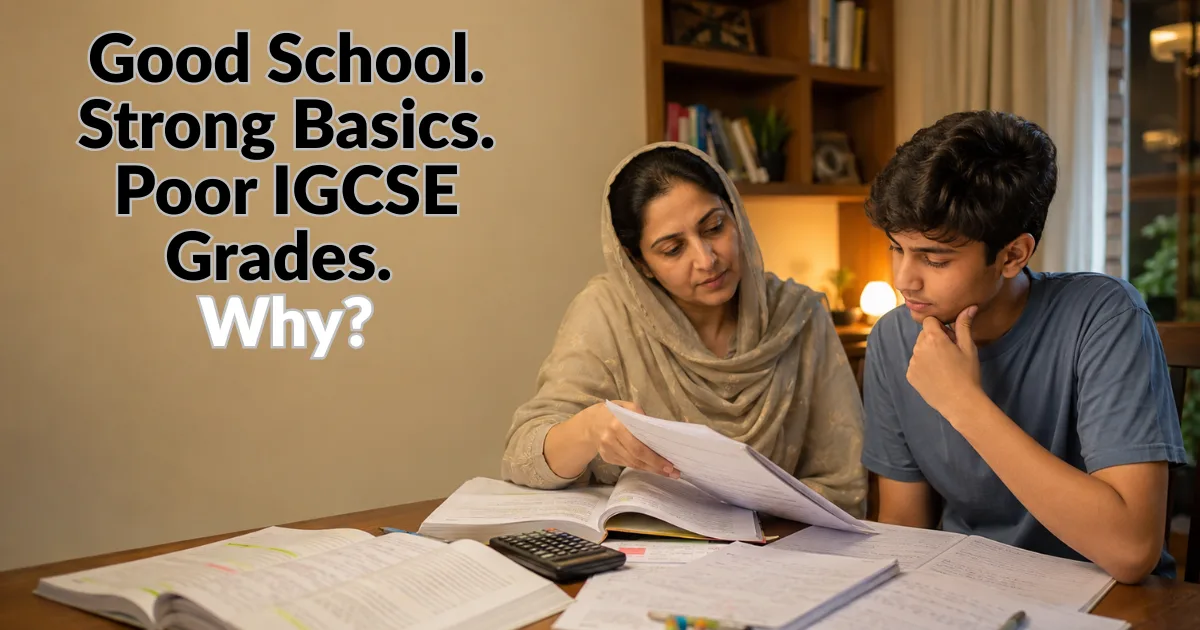
A parent once contacted Tutify a few months before her child’s IGCSE examinations. He attended a well-known school, understood most lessons and had never been considered a weak student. Yet when we gave him a complete past paper, he struggled to finish it without help.
He knew the content, but he had not learned how to turn that knowledge into examination marks. He forgot formulas, misread command words, left out essential working and had little experience using an official mark scheme.
This is not an unusual case.
Since 2021, more than 800 students have learned with Tutify through one-to-one online lessons for Cambridge IGCSE, Pearson Edexcel International GCSE and AQA qualifications. While working with students from different schools and countries, we have seen the same pattern repeatedly: capable students often underperform not because they lack intelligence, but because the system around their preparation is weak.
Here are the five most common reasons.
1. Parents believe going to a good school is enough
A good school matters. Good teachers, organised lessons and regular assessments can give a student a strong academic foundation. However, no school can replace the independent work that must happen after the school day ends.
Schools teach the syllabus, but students still need to revise formulas, practise questions, identify weak topics and solve IGCSE past papers at home. A teacher may explain trigonometry perfectly in class, yet the student can still forget the method if it is not practised independently. The same applies to mole calculations in Chemistry, forces in Physics and structured responses in Biology.
IGCSE success is not based only on understanding a lesson. Students must remember the content, apply it in unfamiliar situations, manage their time and present answers in the form expected by the examiner.
Key takeaway: School gives the lesson. Independent practice turns that lesson into marks.
Parents do not need to teach every subject themselves. Their role is to create structure and accountability.
Instead of asking, “What did you study at school today?”, ask:
What did you practise independently?
Which questions did you find difficult?
Did you revise any formulas or definitions?
Did you check your answers using a mark scheme?
Is there a topic you are currently avoiding?
A student may attend every class and still fall behind if there is no system at home.
2. Students leave IGCSE past papers until the final months
This is one of the most damaging mistakes we see.
Many students believe they should complete the entire syllabus first and begin past papers close to the examination. By that time, they may know the chapters but have very little experience applying that knowledge under examination conditions.
IGCSE past papers should be used from the first topic, not saved for the final months.
Suppose a student has completed trigonometry in Mathematics. If the qualification includes Paper 2 and Paper 4, the student should begin solving topic-wise trigonometry questions from both papers.
A useful starting routine could be:
Solve 15 questions from Paper 2
Solve 15 questions from Paper 4
Mark every answer using the official marking scheme
Identify where marks were lost
Write down difficult questions
Attempt the same questions again without help
Checking only the final answer is not enough. Students should study where marks are awarded and whether their method, working and presentation match the examination requirements.
They should ask:
Did I show enough working?
Did I use the correct formula?
Did I misunderstand the question?
Did I lose marks because of careless calculation?
Could I solve this question again tomorrow without help?
Past papers teach something that ordinary revision cannot. They show students how the same topic can appear in different forms.
A student may understand a chapter when reading the textbook, but that does not mean the chapter has been mastered. If the student cannot answer topic-wise past-paper questions independently, the topic is not yet secure.
Parent warning: Familiarity creates false confidence. The chapter looks familiar, so the student assumes it has been learned. The past paper reveals the truth.
The first time a student sees an unusual question should never be inside the real examination hall.
3. Students do not have a fixed evening study routine
The early months of IGCSE often feel comfortable. The examinations appear far away, the workload still seems manageable and both parents and students assume there is plenty of time.
This is usually when the problem begins.
Evenings slowly become filled with phones, games, social media, outings and too many extracurricular activities. One unfinished chapter becomes three. Three become eight. By the time the first disappointing test or mock result arrives, the student may already be carrying weaknesses across several subjects.
A fixed evening study period is essential during Cambridge IGCSE, Pearson Edexcel International GCSE and AQA preparation.
This does not mean students must spend every hour studying. Rest, exercise and healthy activities still matter. However, study time must be protected rather than fitted into whatever time remains.
A focused evening routine should answer four questions:
What time will studying begin?
Which subjects will be covered?
What must be completed?
Where will the phone remain?
Even 90 minutes of focused work can be more valuable than several hours of distracted studying.
A simple evening routine may include:
Review the topic taught at school.
Read the relevant textbook section.
Complete worked examples independently.
Solve practice questions.
Attempt topic-wise IGCSE past-paper questions.
Mark the answers.
Record mistakes and questions for the teacher.
The purpose is not to keep the student busy. The purpose is to create visible progress every day.
The real danger is not one missed evening. It is allowing unstructured evenings to become the normal routine.
These habits also matter beyond IGCSE. A student who learns to sit, focus and complete work independently is preparing for A Levels, university and professional life.
4. Parents wait too long before getting help
Every year, Tutify receives urgent messages during the final months before examinations.
“My child has not completed the syllabus.”
“Please do anything.”
“Can you cover everything before the exam?”
“Charge whatever is needed, but help them finish.”
At that stage, parents are often willing to spend more. The problem is that time cannot be purchased.
A tutor can help the student prioritise important topics. A teacher can solve urgent questions and improve examination technique. A crash course may strengthen selected areas. However, no honest teacher can replace months of steady preparation in a few weeks.
This is where the domino effect begins.
A student who does not understand algebra may later struggle with equations. Weak equations can make graphs more difficult. Once graphs become confusing, several later Mathematics topics also become harder.
The same pattern appears in Science:
Weak mole calculations can affect several Chemistry chapters
Weak force concepts can create difficulty across Physics
Weak cell biology can affect later Biology topics
Weak data handling can damage practical and structured questions
One unresolved weakness pushes the next topic down.
That is the domino effect.
Parents often believe they are saving money by delaying tuition or academic support. Later, they may spend much more on urgent lessons and last-minute preparation while the student is already stressed.
A better approach is to begin earlier with a manageable monthly package. This gives the student time to understand concepts, practise IGCSE past papers, correct mistakes and improve steadily under expert guidance.
The best time to get help is when the weakness is still small.
Not when the examination is one month away.
5. Students replace textbooks with short notes
Short notes are useful. They help students revise definitions, formulas and key points quickly before a test.
But short notes are not a replacement for proper learning.
Many students now want every topic in the shortest possible form. They look for one-page notes, quick videos, important questions and teacher summaries. This may feel efficient, but it often creates shallow understanding.
IGCSE examinations do not only test whether a student remembers a sentence. They test whether the student understands the idea well enough to apply it in a different situation.
A short note may tell a student what a mole is. A reliable Chemistry textbook explains the concept, shows worked examples, connects it to calculations and demonstrates how the idea is used in different questions.
Every IGCSE student should have one suitable textbook for each subject. The book should match the examination board and syllabus. Parents can check the official Cambridge, Pearson Edexcel or AQA guidance, or ask Tutify for help choosing an appropriate book.
Consider a student who has completed the chapter on moles at school. This should be the next study process:
Read the complete section
The student should read the textbook carefully rather than jumping directly to a summary.
Highlight important definitions and ideas
Definitions should be understood before they are memorised.
Study every worked example
The student should cover the solution and attempt the example independently.
Write key points in their own words
This reveals whether the idea has actually been understood.
Solve topic-wise past-paper questions
The student should apply the concept using real IGCSE examination questions.
Check the official marking scheme
They should identify exactly where marks were gained or lost.
Return to the teacher with specific questions
Instead of saying, “I do not understand moles,” the student can ask about the exact step or calculation causing difficulty.
If the student can solve the questions independently, the topic is becoming secure. If not, they should return to the textbook, review the examples and seek help.
This process may appear slower at first, but it saves time later. A student who learns a topic properly does not need to relearn the entire chapter before every examination.
Short notes should come at the end of learning, not at the beginning.
The real problem is usually not ability
Most students who struggle in IGCSE are not weak. They are working without a complete preparation system.
They may attend a good school but practise too little at home. They may study every chapter but delay past papers. They may have free evenings but no fixed routine. They may need support but ask for it too late. They may revise from short notes without developing deeper understanding through textbooks and worked examples.
When these five mistakes come together, even a capable student can collapse under examination pressure.
The good news is that every one of these problems can be corrected.
Parents do not need to wait for a poor school report or mock examination result. Starting early, protecting evening study time, using reliable textbooks, solving topic-wise IGCSE past papers and seeking support quickly can prevent small academic gaps from becoming serious problems.
A student’s final IGCSE grade is rarely decided in the last month. It is usually decided by what happens every evening during the months before it.
The Parent IGCSE Readiness Check
Give your child one point for every statement that is true:
My child has a fixed evening study period.
My child solves topic-wise IGCSE past-paper questions every week.
My child checks answers using official marking schemes.
My child keeps a record of mistakes and weak topics.
My child uses a suitable textbook for each subject.
My child asks for help as soon as a topic becomes unclear.
5 to 6 points
Your child has a strong preparation system. Continue monitoring consistency and weak topics.
3 to 4 points
Some good habits are present, but important gaps may still affect the final grade.
0 to 2 points
Your child may be attending classes without fully preparing for IGCSE examinations.
Do not panic, but do not ignore the warning signs. The earlier the missing part of the system is identified, the easier it is to correct.
Is attending a good school enough for IGCSE success?
No. A good school provides teaching, classroom structure and assessment, but students still need independent revision, textbook study and regular past-paper practice at home.
When should an IGCSE student begin past papers?
Students should begin topic-wise IGCSE past-paper questions immediately after completing each topic. Full yearly papers can become more frequent once a larger part of the syllabus has been covered.
Are short notes enough for IGCSE preparation?
Short notes are useful for revision, but they should not replace a reliable textbook, worked examples, syllabus coverage and official past-paper practice.
Which of these problems is affecting your child?
Tutify provides one-to-one online tutoring for Cambridge IGCSE, Pearson Edexcel International GCSE, AQA, GCSE and A-Level students.
Our teachers do more than explain chapters. Students practise topic-wise and yearly past papers, review their mistakes using official marking schemes and receive focused support in the areas holding them back. Parents also receive clearer visibility into the student’s progress.
Unsure where your child is currently struggling?
Book a free 60-minute one-to-one trial class with Tutify. We can help identify the gaps in your child’s current IGCSE preparation before they become harder to correct.
Because the best time to solve an academic problem is not one month before the examination.
It is when the first warning sign appears.
Share